RTP and Volatility Explained Without the Maths Lecture
RTP and volatility sound more complicated than they are. Here is the plain-English version, plus how to use both figures without reading too much into them.

RTP and volatility are two of the most useful slot terms to understand, but neither tells you what will happen on your next spin. One describes a game’s long-run theoretical return; the other describes the sort of ride its payouts may create.
Key takeaways
- RTP is a game’s theoretical return across a very large number of spins, not a promise for one player or one session.
- Volatility describes the likely pattern of payouts, from more frequent smaller wins to less frequent, larger swings.
- Use RTP and volatility together as comparison tools, then play only within a limit you are comfortable losing.
What RTP actually means
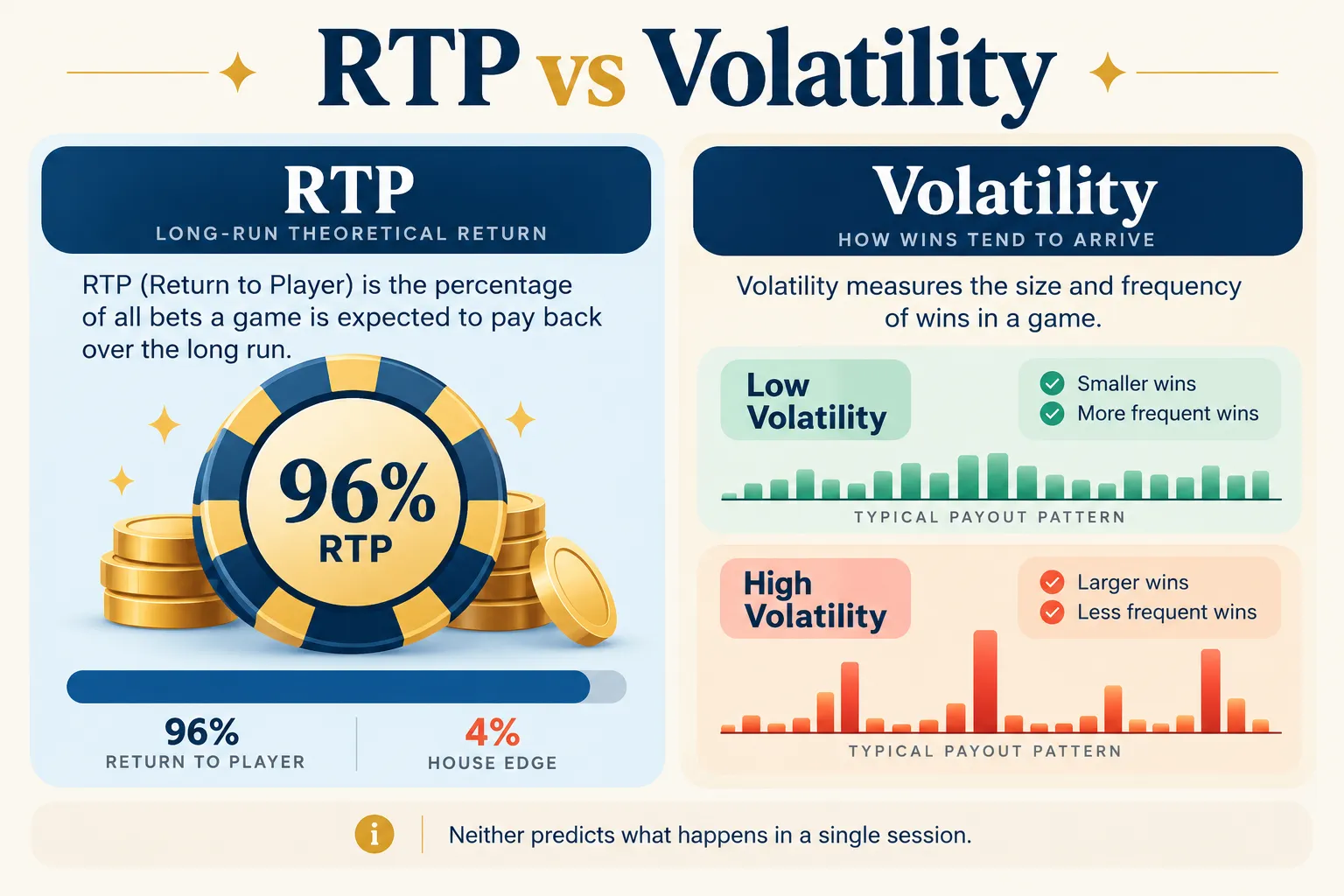
RTP means Return to Player. It is shown as a percentage and represents the amount a game is designed to return to players over a very large number of spins.
Take a slot with a 96% RTP. In the long run, it is theoretically designed to return £96 for every £100 staked across all play, leaving £4 as the house edge. That does not mean you will get £96 back from £100 yourself. A short session can land above or below that figure by a mile. Slots are not known for politely evening things out before tea.
RTP is best used as one comparison point when choosing between games. A higher listed RTP means a smaller theoretical house edge, but it is not a prediction, a refund rate or a route to a profit.
What volatility means
Volatility, sometimes called variance, is about how a slot tends to distribute its payouts. It is not a measure of how generous a game is overall.
A lower-volatility slot may produce smaller wins more regularly. A high- or very-high-volatility slot may have longer quiet spells, with payouts more concentrated in less frequent moments. Neither style removes the risk of losing money; they simply feel different while you play.
RTP and volatility at a glance
RTP
A long-run theoretical percentage showing how much of total stakes a game is designed to return to players over many spins.
Volatility
A description of how payouts may be distributed during play. It does not predict the size or timing of your next win.
How the two fit together
RTP answers: “What is the game’s theoretical return over the long haul?” Volatility answers: “How might wins be spread out along the way?” They are related only in the sense that both help describe a game; one does not determine the other.
For example, Bait 'n' Bank is listed with 96.37% RTP and low volatility, while Baba Yaga is listed with 96.69% RTP and very high volatility. The RTP figures are fairly close, but the supplied volatility ratings suggest potentially very different session patterns.
Likewise, a high RTP does not automatically mean a gentle game. Aces and Eights is listed at 99.09% RTP, but no volatility rating is supplied here, so it would be a mistake to assume how often it pays from RTP alone.
A practical way to use both
Start with the kind of experience you want, rather than hunting for a magic percentage. If you prefer a steadier pace, lower volatility may suit you better. If you understand that quieter runs can be part of the deal and prefer bigger swings, high volatility may be more your thing.
Then check the RTP shown for the exact version of the game where you are playing. RTP is a long-run theoretical figure, and game versions can matter. Finally, set a spending limit before you start and treat the stake as entertainment money, not money with a job to do.
Mentioned in this article



RTP is the game supplier's default figure; individual casinos may configure a different value.